This post may contain affiliate links; by clicking on and buying through these links I will earn a small commission, at no extra cost to you: helping me to keep Blind Girl Adventures running.
Travelling to San Francisco alone, without my now retired guide dog Ida, was always going to be different. This wasn’t a sightseeing holiday or a press trip packed with itineraries and reviews. It was a six-day work visit split between two accessibility conferences, with very little time to play tourist.
But solo travel, especially as a blind person, always finds a way to be memorable. From navigating unfamiliar transport systems to meeting complete strangers who became trusted friends, San Francisco tested my resilience and rewarded me in equal measure.
This post isn’t a list of ‘top ten things to do’ or a perfect itinerary. It’s a story about real travel as a disabled person. It’s about movement, mishaps, and moments of human connection that stayed with me long after I boarded the flight home.
Day 1: Flying to San Francisco as a blind solo traveller
My journey began in London, catching the Elizabeth Line to Heathrow Airport. UK Rail Passenger Assistance made the process seamless, supporting me every step of the way, from boarding the train to arriving at the airport. Travelling my now retired guide dog Ida meant I was relying solely on my cane and the kindness of strangers, and I wasn’t disappointed.
At Heathrow, airport staff helped me check in, breeze through security, and settle into the lounge. Priority Pass is a fantastic way of getting access to lounges: it takes you out of the hustle and bustle of the airport and, in my case, allowed for several cups of tea before the flight.
Although I came dangerously close to missing my flight, through no fault of my own. Passenger assistance had forgotten about me. Thank goodness they have the buggy service, because I definitely would not have made it to gate 25 in time.
What caught me off guard most was that, as we were passing by, a woman using crutches attempted to flag down the staff member accompanying me, saying she too had been forgotten. As I rushed aboard, frantically apologising to the cabin crew, an announcement came over the tannoy calling for a final passenger, the very same woman left behind, who was desperate not to miss her flight. I explained what had happened and, thankfully, she made it.
The eleven-hour Delta flight to San Francisco was a mix of nerves and excitement. It was my first time visiting the city, I was speaking at the TravelAbility Summit, and catching up with fellow blind travellers at the Blind Travel Summit.
I really wanted to be a tourist, but I also knew that my limited energy and the extra time required to navigate an unfamiliar city without Ida would change the pace of my days.
My journey was made lighter by meeting Abi and her husband, who were off to San Francisco for their honeymoon. The cabin crew felt like family, helping me find my seat, and Abi assisted me with the entertainment system.
Pre-pandemic, visually impaired passengers flying with Virgin Atlantic or their partners would receive an iPad onboard to access the inflight entertainment more accessibly. As you might have guessed, that is no longer considered worth reinstating, because, apparently, access just is not a priority.
Accessible Transport from San Francisco Airport to HI San Francisco Fisherman’s Wharf Hostel
At San Francisco International Airport, I was met with a wheelchair for assistance, a common practice in the US, and escorted through the terminal.
I bought a BART ticket ($10.40 one-way to downtown) and hopped on the train. San Francisco’s BART system impressed me with its audio announcements and audible door signals, making navigation manageable.
While it doesn’t offer staff assistance like in the UK, the kindness of fellow passengers helped me find the right stop for Fisherman’s Wharf.
After an adventurous bus ride from the BART station and some confusion finding my destination, I stumbled into the House of Illusions, a small attraction where the staff kindly connected me to Wi-Fi as my data wasn’t working.
I ordered an Uber to the HI San Francisco Fisherman’s Wharf Hostel (240 Fort Mason, San Francisco, CA 94123) and checked into the ADA-accessible section.
Where I stayed: HI San Francisco Fisherman’s Wharf Hostel

I stayed at HI San Francisco Fisherman’s Wharf Hostel, located inside the historic Fort Mason complex. The building dates back to 1863, originally built as army barracks during the Civil War, later used as a military dispensary during the Second World War, and eventually converted into a hostel in the 1980s.
It’s the oldest hostel in the city, and it shows: solid walls, high ceilings, and the kind of calm atmosphere you don’t often find in budget accommodation.
There’s no lift, so unless you’re staying in the ADA-compliant section on the ground floor, this hostel may not suit every disabled traveller.
I was booked into the accessible wing, which is a separate key card protected space exclusively for guests with access needs. That restriction creates a noticeably quieter and more respectful environment.
The layout is simple but effective. There’s a large accessible kitchen with modern appliances, a spacious communal lounge, and a shared bathroom with a roll-in shower and grab rails. The lounge, laundry facilities and café are also located on the first floor, which makes a real difference when you’re travelling solo as a disabled guest.
Each bedroom opens directly onto this main area, which makes navigation easier: no long corridors or unnecessary detours.
My room had a double bed with top bunk, carpeted floor, and plenty of clear floor space. The decor was minimal: white walls, wooden floors in the shared areas, and practical furniture. Nothing overstated, but clean and easy to orient.
The café and yoga room are also on this floor, so if you’re staying in the ADA wing, everything essential is within easy reach.
Café Franco serves breakfast and lunch and has outdoor seating that looks out over the bay. There’s also a sun terrace with picnic benches, perfect for a quiet cup of tea with views of Alcatraz and the Golden Gate Bridge.
What really stood out here was the staff: they gave me a guided tour to help me orient myself, and escorted me downstairs for the free breakfast: always with a warm welcome and good conversation.
Of course, I could’ve made something in the perfectly functional accessible kitchen upstairs, but who passes up a free breakfast?

Elsewhere in the hostel you’ll find a cinema room, game room, guest lounge and additional kitchen, but these are down a flight of stairs.
There’s free Wi-Fi throughout, laundry facilities on site, and even free parking, which is rare for San Francisco.
The hostel also runs regular activities like walking tours and film nights: easy to join, and low pressure if you’d rather keep to yourself.
HI San Francisco Fisherman’s Wharf Hostel feels like a retreat. The location, the slower pace, and the layout of the accessible wing make it a rare example of a hostel that gets it right.
Day 2: Photo Shoot And Unexpected Adventures
The morning was spent on something a little different: I had the chance to take part in a very cool project with Jessica from the HI hostels team.
I worked as a model for an accessibility-focused photoshoot, led by the brilliant photographer Sarah, capturing how disabled travellers move through and use the hostel’s communal spaces, from the accessible kitchen and lounge to the bedrooms and shared bathroom.
Sarah described each setup clearly so I could visualise what we were creating, and Jessica brought such warmth and positivity to the experience. It felt relaxed, collaborative and refreshingly genuine.
I met Danielle and Zhane, a lovely LGBT couple who were also models for the shoot. Spending time with them was a joy: they brought so much energy, humour and authenticity to the day.
I loved being represented not just as a blind person, but as a model with lived experience, contributing to something that might help future travellers feel welcome before they even arrive.
After finishing up my work at HI San Francisco Fisherman’s Wharf Hostel, I debated whether to rest in my room or go for a stroll. The marina was right on my doorstep, and even though I couldn’t see Alcatraz or the Golden Gate Bridge, I knew they were there.
I’d planned to use Aira, my visual interpreter app, to help me take in the view and navigate to a nearby vantage point.
As I was walking with Aira’s assistance, a lovely lady approached and asked if I needed help. I assured her I was fine, but when I mentioned I was heading towards the marina, she smiled and said she was too.
She offered to walk with me, and I happily accepted. I ended the Aira session and we continued together, chatting as we went.
Her name was Connie. She was living with low vision and had just received her first long white cane. What followed was one of those rare encounters that feels entirely fortuitous.
We bonded instantly over our love of travel, dogs, psychology and the philosophy of life. It felt like we were meant to meet, two strangers on parallel paths, sharing not just a walk, but a genuine moment of connection.
Connie took me along the waterfront, describing her favourite hidden spots with such love and detail. This was her daily route, and she knew it intimately.
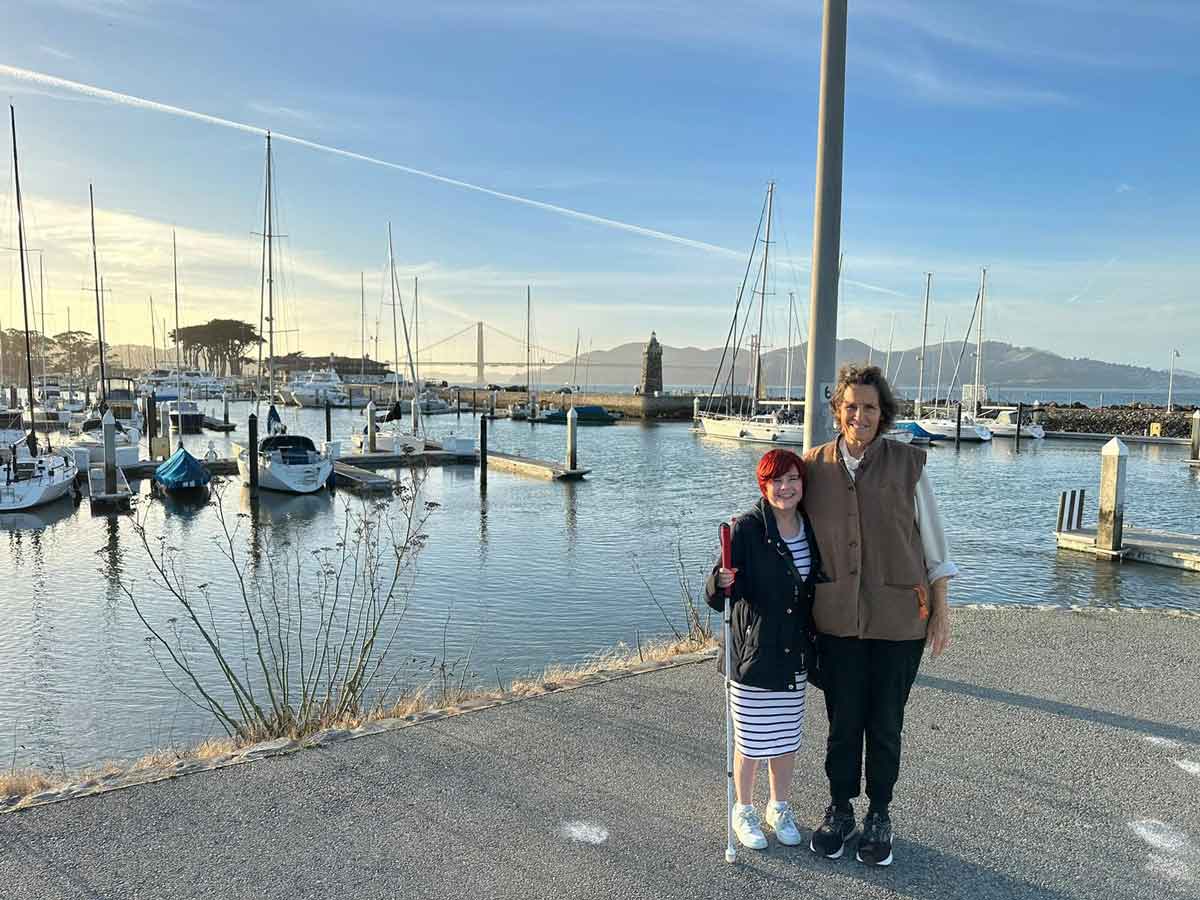
She helped me navigate to a picturesque viewpoint and even guided me into position for a photo in front of the iconic Golden Gate Bridge, describing the scene so clearly I could almost see it.
The whole experience felt calm, easy and full of meaning. A quiet reminder that some of the best moments in travel aren’t planned, they find you.
Day 3: Attending the Blind Travel Summit in San Francisco
The Blind Travel Summit, held at Lighthouse for the Blind, took place over the morning and early afternoon. I loved being in the company of other blind travellers, sharing stories and ideas.
Leaving the Blind Travel Summit at the Lighthouse for the Blind, I felt a surge of pride. Navigating a new city is always an adventure, but doing it independently while carrying a giant rucksack full of clothes for almost two weeks, all while filming myself, felt like a triumph.
I had the camaraderie of other visually impaired attendees, which was reassuring, but the real highlight was what came next.
My friend Mike and I decided to try something extraordinary for the ride over to the Argonaut Hotel. We booked a Waymo, a self-driving car service.
It was my first time in a driverless car, and the experience was a mix of pure fun and exhilaration. We captured some epic footage, and the whole narrative of two visually impaired travellers hopping into an AI-powered vehicle felt like a glimpse into the future.
Full of adrenaline and and make more friends arriving at the hotel.
We arrived at the TravelAbility Summit. I checked into the Argonaut Hotel, where I stayed for the next two nights, and joined the opening sessions.
The Argonaut Hotel, located at Fisherman’s Wharf, is full of maritime charm, with navy and white interiors, ship-inspired decor, and porthole-style mirrors.
Day 4: Speaking at TravelAbility and promoting accessible tourism
This was one of my busiest days. Speaking about accessible travel, content creation and what it’s like to navigate the world as a disabled person was a true highlight, especially getting to share the stage with other major players within the world of accessible travel! Spent the rest of the day networking with professionals, advocates, and organisations determined to make the travel industry more inclusive.
The discussions were dynamic and energising, and it felt powerful to be part of a global conversation about accessible travel.
I was welcomed so warmly by Jake, Trisha, Lauren and Carolina, who made me feel genuinely supported throughout the summit. Whether it was helping me navigate the event space, joining me for a catch-up over tea, or congratulating me after my talks, their kindness made all the difference.
One of the most powerful connections I made at the summit was with Taylor. She’s sharp, grounded and full of passion and determination. She had incredible people with her: Addison, Anthony and her partner Tommy. I really enjoyed all four of their company.
It was only later that I found out Taylor is a filmmaker. She lost her vision suddenly while studying film at Colorado State University, right in the middle of her degree. She didn’t walk away, she adapted how she worked and carried on writing and directing.
In 2022, she wrote and directed Sol, a coming-of-age short film about a young Latina woman preparing to leave home and step into adulthood. It’s a story about identity, family and figuring out how to move forward. She directed the entire project as a blind filmmaker.
Her story has since been featured in a PBS documentary called Taylor’s Vision, which is now available to watch online.
She’s currently directing The Blind Movement, a documentary series following four blind friends as they travel across America. In each episode, they meet another blind person and help bring one of their bucket list dreams to life, supported by their local community. Taylor leads the project as director, with Addison and Anthony producing.
Addison and Anthony are thoughtful, passionate and clearly invested in telling disabled stories with care. Tommy was lovely too. It was a genuine pleasure getting to know all four of them, and Taylor’s focus, clarity and creative leadership really stayed with me. She’s a force to be reckoned with and I definitely think she’s going to go far.
Day 5: Exploring San Francisco by night with a fellow blind traveller

After another action packed and knowledge filled day where I had the honour of speaking again, it reminded me what it’s truly like to feel part of a community. People who get you, want the same changes as you and striving for a more inclusive world, that in itself was empowering.
I checked out of the Argonaut and into HI San Francisco Downtown Hostel for my final two-night stay.
That evening, I met up with a newly made friend Kevin: a visually impaired Travel loving human who just happens to to live in San Francisco. He became my Tour Guide for the evening.
We set off from HI San Francisco Downtown Hostel just as evening fell.
From its central location, a short walk from Union Square, we stepped into the heartbeat of the city: the clang of passing cable cars, the low hum of buses, and the scent of late-night food trucks drifting on the breeze.
Heading north along Powell Street, the sidewalks were alive with shoppers and glowing storefronts. As the street sloped gently upward, we reached Chinatown.
One of the oldest and most vibrant Chinese communities in North America, Chinatown hums with life. Red lanterns swung gently overhead. The smell of incense drifted from doorways tucked between bakeries and herbal medicine shops. Conversations in Cantonese rose and fell around us, punctuated by the clatter of woks and the hiss of oil escaping hot pans.
We had dinner at Z & Y Restaurant, which came highly recommended by locals and absolutely did not disappoint. We shared a mix of dumplings to start, followed by duck pancake rolls: Kevin’s first time trying the dish this way. The flavours were bold, rich and comforting. We talked, laughed and explored a cool November evening in San Francisco, our canes tapping the pavement as we soaked it all in.

From there, we wandered into North Beach, the city’s Little Italy. The air was thick with garlic and tomato sauce from nearby trattorias. Jazz music spilled from dimly lit bars, neon signs buzzed quietly above our heads, and the pace felt slower: more intimate, more romantic. Coit Tower glowed softly in the distance as we continued west.
Eventually we reached the Marina District. The streets widened and the atmosphere opened up. I could smell salt from the nearby bay, hear the soft creak of sailboats in their moorings and the rhythmic thud of joggers’ footsteps on the path. The houses grew larger here, bright and modern, and the stillness was striking after the buzz of downtown.
Ever up for the challenge, Kevin asked whether I wanted to walk up to Lombard Street. Of course I said yes, although I may have had to pause for a brief moment at the top of the hill before we hit the stairs. Kevin is a speed walker, so I definitely got my cardio in that night.
As we zigzagged uphill through Russian Hill, the streets narrowed again. Classic San Francisco homes lined our path: pastel-painted façades, bay windows, steep front steps and neat gardens filled with lavender and rosemary. I could smell the flowers blooming and hear the soft rustle of hedges brushing against their gates.
I couldn’t see the twists and curves of Lombard Street anymore, but I could feel the slope beneath my feet and the buzz of visitors gathering around us. That incline, that atmosphere, it’s all still there, just experienced differently.
It was a joy to take the city in by foot. Every corner, every scent, every sound brought San Francisco to life in a way that made me happy, not sad, that I don’t see these famous spots anymore. And yes, we took plenty of photos too.
We jumped on the 28 bus to head across to the Golden Gate Bridge. The audio announcements were clear and helpful as we made our way toward the Presidio.
Then came the real surprise: the 3D, to-scale tactile model of the Golden Gate Bridge. I was in awe. I knew I was standing right next to the real thing, the traffic whizzing by was impossible to miss, but being able to physically reach out and touch an exact scale model, colours and everything, brought a moment of pure ecstasy to my heart that I will never forget.

We paused and decided to call Aira for a visual description. The agent described a perfect moment: the moon glowing bright in a deep blue sky, Kevin looked up and there it was. Can you imagine being under the glow of a bright moon while standing in such a picture perfect spot? That simple image stayed with both of us, like a quiet reminder of where we were and what we were doing: two blind travellers experiencing the city on our own terms.
I don’t care whether you’re a visually impaired or sighted traveller, this is a must see if you’re in San Francisco.
Where I stayed: HI San Francisco Downtown Hostel
Just a few blocks from Union Square, HI San Francisco Downtown Hostel had a very different feel to Fort Mason. If that one felt like a quiet retreat, this one was more like a big family home: lively, central, and full of movement.
I stayed in a Queen Suite with a private ensuite. The room was carpeted, spacious, and easy to navigate with my cane. There was a queen bed, a desk and seat area, and plenty of space to get around.
The decor throughout the building was a collection of colours and textures, particularly in the communal areas giving a real homely vibe than HI San Francisco Fisherman’s Wharf Hostel.
The building has a lift and there are accessible bathrooms on each floor. The corridors were narrower, but manageable.

The staff were excellent: welcoming, helpful, and happy to give me a full orientation and help me find my room. Everything was level access, and I felt confident navigating independently once I’d settled in.
I slept well on my first night, but was woken early the next morning by a labour protest happening just outside. The windows weren’t double-glazed, so there was no blocking the sound.
If you’re sensitive to noise, it’s something to keep in mind, but that’s part of staying in the centre of a busy city.
There’s a large communal kitchen, a shared lounge, and regular activities for travellers wanting to meet others or explore the city.
Wi-Fi is free throughout, and I felt safe and well supported during my stay.
While it didn’t have the same stillness as Fort Mason, it offered convenience, energy, and accessibility, with excellent staff who made the experience smooth from the moment I arrived.
Day 6: Reflections on blind solo travel in San Francisco

On my final full day in the city, I spent time with Connie again. One of the most memorable meals I had in San Francisco was also one of the most unexpected. Tucked inside San Francisco Centre, I discovered Mashaallah Halal Pakistani Food, a family-run spot serving traditional Indian and Pakistani dishes with care, pride and unmistakable authenticity.
I ordered the chicken tikka masala with rice. The sauce was thick and velvety, with deep tomato richness, warming spices and a soft, smoky finish. The chicken was beautifully tender, marinated through and full of flavour, falling apart gently as I ate. The rice carried the sauce perfectly, soaking up the spice without losing its texture.
Connie kindly shared her cup of masala chai. I’d never tried it before. It was sweet, milky and far more subtle than I expected. Just the faintest hint of cardamom and ginger in the background. I could see why it’s so loved: comforting, smooth and easy to sip. It felt like the kind of tea you drink slowly, with good company.
Connie told me the food tasted exactly like the meals she enjoys when visiting India. The kitchen is run by a Pakistani family, and you can feel the heritage and tradition in every dish. There’s something about the way family recipes carry across generations that no recipe book can replicate.
I loved getting to know Connie on an even deeper level, and we both noted upon on our fortuitous meeting, feeling like it was somehow meant to be.
This was Connie’s first time using her cane out in public after receiving it just days earlier, it felt like a poignant moment for both of us; she building her confidence and me, seeing this wondrous city through yet another lens. We whiled away the day with retail therapy and relaxing in the HI San Francisco Downtown Hostel lobby.
I felt like I could sit all night and speak with Connie but a very early morning wake up call was beckoning me to at least try and grab a few hours sleep before my 7 AM flight to Boston.
It was a relaxed and grounding end to what had been a whirlwind trip.
Practical tips for accessible travel in San Francisco
• Transport: The BART system has audio announcements and clear signals, but no dedicated assistance. Plan ahead and ask locals if needed
• Hostel recommendations: HI San Francisco Fisherman’s Wharf Hostel is quiet, with a fully accessible ADA wing. HI San Francisco Downtown Hostel is lively, central, and has accessible rooms and bathrooms.
My time in San Francisco was truly extraordinary, not just because of the city’s vibrant charm but also the incredible people I met along the way. Each encounter added a unique layer to my adventure, making it a journey I’ll always cherish. I can’t wait to return and discover even more of what this amazing city has to offer.
Have you ever been to San Francisco? Would you consider staying in a hostel for your own adventure? Share your thoughts in the comments below.
For more similar articles, check out my recommendations below:
Like it? Pin it!

I am a 43 year old blind man and I love to travel. I have shared similar experiences as these that you so deftly describe, Sassy. It’s been awhile since I winged it to go to Europe and travel alone there, and your article brought me renewed inspiration to do some more solo exploring. I haven’t checked out AIRA yet so I am going to do that. And congrats on your awesome adventure! Maybe our paths will cross. If you are ever in Los Angeles, look me up. 🙂
wow