

This post may contain affiliate links; by clicking on and buying through these links I will earn a small commission, at no extra cost to you: helping me to keep Blind Girl Adventures running.
Guide Dog Retiring Process: Retiring a guide dog in the UK is a major transition for you and your guide dog, but it’s also about recognising when they’re ready to take a well-earned break and can actively enjoy this change of pace.
When Do You Know It’s Time to retire your guide dog?
Retirement doesn’t happen suddenly—it’s something you notice over time. With Ida, I’ve already started seeing some signs that her working days are nearing their end.
Guide Dog Retiring Process:
Age
Most guide dogs retire around 8 to 10 years old, but it’s not a fixed rule. It depends on their health, breed, and workload. Every dog is different, but generally Guide Dogs UK start to prepare you mentally when your dog has reached 8 years old, and this will be discussed during your yearly after-care visits with your Guide Dog mobility specialist (GDMS).
As Ida will be turning 10 years old on the 5th of May 2025, it was pre-agreed that this would be a good time and age for her to retire.

Health
Ida is already showing signs that her body is feeling the effects of years of guiding. Some days, she’s got her pep back and moves like her younger self, but on others, it’s clear she’s struggling. She’s started licking her paws and joints far more often, I can hear her joints click and I can see she’s far more stiff first thing in the morning -especially after a busy day at work or after tearing around the park like a puppy. It’s her way of telling me she’s feeling some discomfort, and I can’t ignore that.
Behaviour
Ida’s behaviour is shifting too, and it’s hard not to notice. Consecutive days of work just aren’t possible for her anymore, and she’s becoming far more distracted when she’s out with me. She’s started sniffing incessantly, and on a few occasions, she’s even cut across my body to investigate trees or bushes, completely forgetting about guiding me.
That said, she’s still so enthusiastic when it’s time to go out. As soon as I pick up her harness, she’s bouncing around like a puppy. But after about 20 minutes of walking, particularly in our hometown; where there’s nothing new to stoke her curiosity; I can feel her focus and energy start to drop. When we get home, she takes herself straight to bed and naps for an hour, clearly needing the rest.
Guiding Performance
Safety comes first. If Ida can no longer guide consistently or safely, it’s my responsibility to prioritise her well-being and consider retirement when the time comes. This is also another reason for the yearly after-care visits from your guide dog mobility specialist, they can assess the partnership between you and your dog and will have a true perspective, seeing you both from the outside vantage point.
I am writing this at the end of January 2025, having mentally prepared myself for the last year that Ida would be retiring by May 2025.
What Happens Next?
I’ve worked closely with my GDMS to discuss all potential options for Ida’s retirement as a working guide dog.
Guide Dogs UK are brilliant at supporting handlers through this process, and they’ve got the welfare of both you and your dog at heart.
After-care visits
The first step is having a chat with Guide Dogs UK. For us, the time has come.
My guide dog mobility specialist has been out to visit us for our yearly after care visit. Having already agreed upon a loose retirement date/timeline, and seeing Ida’s change of pace and behaviour: a deep and lengthy discussion was had, to begin the preparations, including paperwork on Guide Dogs side, to initialise the retirement process.
Vet Check
During the Guide Dog Retiring Process a full health check would help confirm if medical issues are playing a part in a guide dogs readiness to retire.
Turning 9 years old, vet checkups are increased to 3 monthly visits to help keep an eye on things, and see if there are any detectible changes.
The biggest problem I personally face is that Ida is a very stoic dog: when the vet manipulates her body to check for signs of stiffness or pain, neither seem to be present in Ida’s case because she doesn’t react to this. If anything, she’s more excited that she’s going to be getting fuss and a treat from the vet! This is why it’s vitally important that we, as Guide dog owners, not just pay attention to the changes but advocate for them even if things come back “clear “from the vet.
Ida had a vet checkup yesterday and they have found stiffness and resistance to movement in her hips. This hasn’t officially been diagnosed with arthritis or hip dysplasia because more examinations which would need to be investigated but considering she has been on joint supplements for over a year now, the vet has suggested giving a pain relief.
Again, this has confirmed to everyone involved that choosing to retire Ida now is what is in her best interest.

The Decision
This isn’t a decision I’ve taken lightly, but I know it’s one I’ve made with love, and with Ida’s happiness and comfort as the priority.
I’m not going to lie, I’ve been aware of Ida’s change of pace for around six months now, but due to us moving house in November and personal things going on, I had already started heavily reducing Ida’s workload and leaving her at home for slightly longer periods each time, allowing her to get used to the new changes in our circumstances whilst also maintaining her health and well-being.
With all this in mind, and the previous conversations with my GDMS, I knew our after care visit in January 2025 was going to be heavy. And it was. My guide dog mobility specialist lay everything out, asking our thoughts and opinions on Ida’s retirement, the nuances and complexities of keeping your guide dog after they retire, what happens if you choose to keep your retired guide dog..
Applying to keep your retired guide dog
If you want to keep your guide dog once they have retired, you have to go through an application process where many things are taken into consideration before a panel who then decide if your current circumstances suit keeping your guide dog in retirement.
You have to explain and prove that your current situation, and future circumstances will give your guide dog the best retirement they can have.
- Your Dog is not to be left alone for more than 4 hours per day. As this gorgeous dog has been by your side for years and years, accompanying you wherever you go, leaving them at home, if you have a 9 to 5 – is not fair on The dog and there Well being.
- Exercising your retired guide dog for a minimum of 45 minutes per day, preferably on soft surfaces like grass: as to not impact their joints.
- Who will look after your guide dog (borders) if you want to go on holiday? This ideally should be one person/household, and depending on the distance they live from you, they must be willing to come and stay in your property as the dog ages and may not be as well or physically fit as before.
- How would you get your Retired guide dog to the vet in an emergency? Understanding that your guide Dog no longer has rights under the Equality act 2010 and could be refused entry/access on public transport.
- Stopping/heavily reducing access to busy environments such as pubs, cafés, public spaces and public transport. As this can overstimulate your retired guide dog and potentially confused them to believing they are still working, even without their harness being on.
- Assessing the practicality of your living space and access to parts of your home. This is particularly important as your dog gets older, their mobility reduces and they could be unwell and unable to do things for themselves.
For all intent and purposes, I think Grant found the conversation and reality retiring Ida harder to digest than I did.
What Happens to Ida After Retirement?
When she’s ready to hang up her harness, Ida’s future will look very different—but it’ll still be full of love.
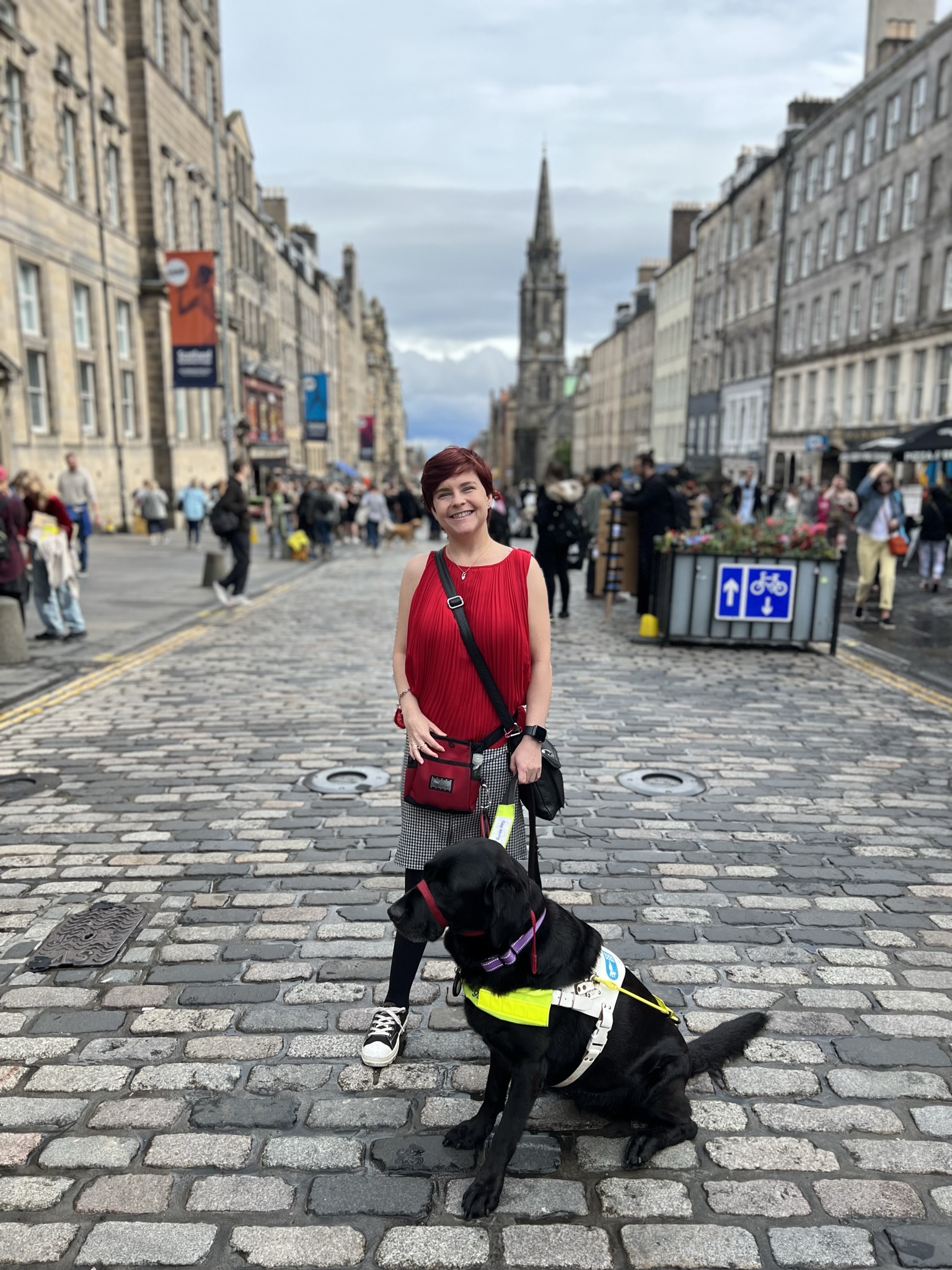
I’m so happy to announce that Ida WILL be staying with us as a pet!!
This was confirmed after my GDMS took our application to keep her in retirement to the panel. Because of my specific circumstances as an accessibility consultant and traveller, I have even more caveats and specifics I have to adhere to but at least we get to keep our baby! She’s part of the family, after all, and I’d want her to spend her retirement relaxing in the home with the people who love her the most!
Rehoming
If for any reason I couldn’t keep Ida, there are 2 more options available to us as Guide Dog owners:
Nominating a home for your retired guide dog
This is where I would select a friend or family member I trust, who Ida also trusts and feels comfortable with, already having a bond with her. They would have to go through an application process for Guide Dogs to assess their suitability. Included the information I’ve already shared above along with other factors including:
- Work/lifestyle balance. If they have a big/busy family, will the retired guide dog be a priority?
- Financial stability. Can they afford to purchase your retired guide dog, pay for food, vet appointments and any medical issues that may arise?
- Keep in regular contact with Guide Dogs UK to ensure the health, happiness and stability of the dog. Updating them with any changes.
Rehoming your retired dog via Guide Dogs UK
Everybody’s circumstances, are different, and as much as the bond and partnership between dog and owner is inseparable, sometimes it is within the best interest of your dog to have the best retirement they possibly can with someone that isn’t you, or someone you know.
I’d trust Guide Dogs UK to find Ida a loving home. Retired guide dogs are often rehomed with their puppy raisers, or they go to families waiting to adopt. They also have to be pre-registered with Guide Dogs UK and meet all criteria shared above.
The biggest potential drawback of having your retired guide dog rehomed with Guide Dogs UK is not having access or contact with your dog once they have left your home. There is zero obligation for the people rehoming your guide dog to stay in contact with you, so if for whatever reason the family chooses not to, you may never see your guide Dog again.
This ultimately is why I couldn’t allow Guide Dogs to re-home Ida. I am far too selfish and cannot bear to part with her. She has been more than just my guide, through a lot of my depression, chronic illness and other medical issues I’ve had over our 8 year partnership. She has also been my therapy dog and my light at the end of the tunnel. Grant and I raised her together and ultimately we owe it to her to give her the happiest life in retirement, and see the journey right through to the end, no matter how heartbreaking it inevitably will be.

Transitioning to Retirement
The official date of Ida’s retirement has not been finalised, but it will be within the next 2 months. I have been advised by my GDMS that the day itself will probably feel quite unsettling, there is no fanfare or award ceremony for my fantastic girl, just some paperwork for us to sign and her harness being removed from our home forever.
Although May 2025 had been the initial date, I have realised that that this is actually too long.
We are in another stage of transition as it is because we have moved, my trainer is assisting us with learning new roots in my local area, however in the two sessions we’ve had It’s evident the timeline needed to be moved closer.
I’m so fortunate that I have the support of Guide Dogs not only to support me through this transition in a practical sense but an emotional want to. Knowing that I can ask for help or utilise services, especially in learning new roots even wants Ida has retired makes me confident that The future will be bright.
Leaving Ida at home as I brush up on my orientation and mobility skills with my long white cane, or when Grant and I pop to the shops is getting us both used to our new life together. Ida is malleable but it hasn’t stopped her cheeky side: finding a warm patch on the sofa, for her new favourite crying at the door for about 30 seconds before she bounces upstairs and jumps directly onto our bed. How do I know this? Grant was in bed and had to use the off command-that definitely gave her a bit of a shock!
As I write this, I have already made the announcement on social media, my emotional state is stable. Mostly because I have new roots to learn, a new house and routine to keep me occupied, and my job to keep me busy.
I don’t doubt that there are going to be days once Ida has finally retired that I’m going to find it difficult. Using a long white cane is a different type of mobility travel, it’s more time-consuming, exhausting and quite honestly frustrating. There are times I’m going to get lost, i’ll be frustrated and probably breakdown and tell Grant “I can’t do this anymore!” but this The only option I have.
This will be a new challenge for me, a good excuse to find new adventures, travel to the extremes of climates which would never have been possible to take Ida, pushing myself to advance my skills and independence whilst using my long white cane.
Ida’s retirement will mean a big change for both of us. She’ll need time to settle into her new routine lounging at home with me, and only leaving the house to go on free runs to the park, which I’m sure she will adopt with enthusiasm, but I’m forever grateful we had 8 years of working partnership together, and I can’t wait to spoil her rotten during her retirement!
If you have been following out guide dog Partnership thank you from the bottom of my heart. Do you have a moment or memory that springs to mind when you think about Ida the guide dog?
Like it? Pin it!

Ida is a true heroine! Everyone loves her! I will miss seeing her at events but happy she will stay in her home!
Very informative Sassy, a big change & adjustment for you all. I hope Ida transitions into retirement smoothly and keeps her cheeky spark (I’m sure she will on both counts! ) and you can enjoy watching her enjoy a quieter pace, as well as looking back on all your precious memories and all the moments yet to come xxx