
This post may contain affiliate links; by clicking on and buying through these links I will earn a small commission, at no extra cost to you: helping me to keep Blind Girl Adventures running.
When you think of space exploration, the Kennedy Space Centre (KSC) in Florida stands as a beacon of human ambition and achievement. This iconic facility, founded in 1962, has launched some of NASA’s most significant missions, including the Apollo Moon landings and Space Shuttle programme. Spanning 144,000 acres, KSC is not just a testament to human ingenuity; it’s also a destination rich in history, education, and inspiration. For a blind traveller, it offers a unique and enriching experience with excellent accessibility features that allow you to engage with the wonders of space exploration in a meaningful way.
I visited Kennedy Space Centre with my husband Grant and our friends, Lauren (who is also blind) and her husband Daniel. We arrived later in the day than planned, completely underestimating the sheer size of the Visitor Complex and the time needed to explore it properly. If you’re visiting, don’t make the same mistake we did—arrive early to make the most of your day- we ended up buying tickets for two days and returned the next day for a full day visit
Shortly after we arrived, we met Noah, one of the incredible staff members at the Visitor Complex, who transformed our visit. Noah gave Lauren and me a hands-on explanation using miniature tactile 3D models of rockets, engines, and an astronaut. Through touch, we were able to comprehend just how massive each component of the rockets is and understand where astronauts are positioned within each shuttle. Noah’s detailed knowledge of the intricacies and history of shuttle launches brought space exploration to life in a way we’d never experienced before. Her passion for the subject made this interaction even more unforgettable, setting the tone for the rest of our visit the next day.
Why Visit Kennedy Space Centre?

The Kennedy Space Centre is where history was made. It’s home to the mighty Saturn V rocket, which launched astronauts to the Moon, and the Space Shuttle Atlantis, a pivotal symbol of modern space travel. The Visitor Complex is divided into various themed areas, each showcasing NASA’s achievements and the intricacies of human space exploration.
Spanning more than 40 acres of exhibits and attractions, KSC Visitor Complex requires careful planning to explore in a single day. Each exhibit offers an immersive experience, with interactive displays, films, artefacts, and models. The average time spent at each exhibit varies, with some taking 30 minutes to an hour, depending on your level of interest.
Exhibits in Detail
Heroes & Legends (1–1.5 Hours)
This exhibit celebrates NASA’s pioneers and features the U.S. Astronaut Hall of Fame. Using multisensory displays, including tactile models of spacecraft, helmets, and astronaut suits, it introduces visitors to the human side of space exploration. The large theatre inside this exhibit uses surround sound and 3D visuals, enhanced by detailed audio guides for blind visitors.
Rocket Garden (30–45 Minutes)
This outdoor area showcases real rockets from the Mercury, Gemini, and Apollo programmes. Standing among these towering giants, some over 100 feet tall, is awe-inspiring. There are tactile displays of rocket components, making it easier to understand their size and structure. Grant described the enormity of the rockets in detail, painting a picture of towering spires reaching into the sky. This exhibit gives visitors a glimpse into the evolution of rocket technology and the challenges NASA faced in launching spacecraft.
I especially enjoyed the tactile plate linked to the “launch a rocket” simulation. Walking on the spot to build steps and send the rocket into space was a simple yet interactive way to engage with the concept of propulsion.
Apollo/Saturn V Centre (2–2.5 Hours)

Accessible via a shuttle bus tour, this exhibit is a highlight. It houses the fully restored Saturn V rocket, which measures 363 feet in length—longer than a football field. Visitors can walk beneath this engineering marvel, touch a real Moon rock, and learn about the Apollo programme’s triumphs and tragedies.
Touching the Moon rock was one of my favourite moments—knowing I was connecting with something that had been on another world was surreal and humbling. The tactile lunar surface model and detailed explanations of Apollo 1’s tragic loss and the triumph of Apollo 11 moved me deeply. These stories bring the human element of space exploration to life.
The shuttle buses to the Apollo/Saturn V Centre are fully accessible, with a lift located in the middle for wheelchair users. Grant described the route to me, pointing out the Vehicle Assembly Building (VAB)—one of the largest single-storey buildings in the world—and the launch pads that have sent astronauts into space. While there is no onboard audio description, his commentary gave me a vivid sense of the journey.
Space Shuttle Atlantis (1.5–2 Hours)

This exhibit is dedicated to the Space Shuttle programme, showcasing Atlantis in all its glory. Suspended mid-air with its payload bay doors open, it’s a monumental sight. Blind visitors can experience a tactile model of the shuttle, allowing you to feel its structure, from the heat-resistant tiles to the orbiter’s nose cone.
Interactive simulations, such as “flying” the shuttle or controlling its robotic arm, provide hands-on engagement. Pretending to be an astronaut in the shuttle simulator was exhilarating. The experience of 4G force, the vibrations, and the brief feeling of weightlessness made it easy to imagine the intensity of being in space.
The exhibit also honours the Columbia and Challenger crews, explaining the devastating missions and their impact on NASA’s future safety protocols.
Journey to Mars (30–45 Minutes)
This exhibit highlights NASA’s plans for future exploration, focusing on the Red Planet. Visitors learn about the technologies being developed to support manned missions to Mars, from spacecraft design to survival systems. A tactile rover model and presentations help blind visitors engage with the material.
IMAX Theatre (1 Hour)
KSC’s two IMAX theatres screen space-themed films, including documentaries about the International Space Station and the Hubble Space Telescope. While there is no audio description available, the soundtrack and narration make the experience engaging and informative.
Meeting an Astronaut
One of the unique experiences at KSC is the chance to meet a real astronaut. Each day, an astronaut shares their personal stories, detailing the challenges and triumphs of space travel. The schedule varies, but these talks are included with general admission.
For an even more intimate experience, you can book the “Chat with an Astronaut” programme. For $50 per person, this session includes a Q&A, signed photo, and refreshments in a private setting. It’s an incredible opportunity to hear firsthand about the realities of life in space.
Accessibility at Kennedy Space Centre
Accessible Toilets:
Accessible toilets are available throughout the Visitor Complex, including near the entrance, the Rocket Garden, the Space Shuttle Atlantis exhibit, and the Apollo/Saturn V Centre. The motion-sensor doors are designed to accommodate mobility aids, though the automatic door opening slowly towards you can be slightly confusing for blind visitors.
Mobility Scooter and Wheelchair Hire:
Wheelchairs and scooters can be hired on-site for $15 and $30 per day, respectively.
We visited in late October, and although autumn had started, the heat was intense, with temperatures at 30°C The air-conditioned buildings were a welcome relief, and it’s worth noting that most of the exhibits are indoors, making it easier to escape the heat.
Personal Highlights

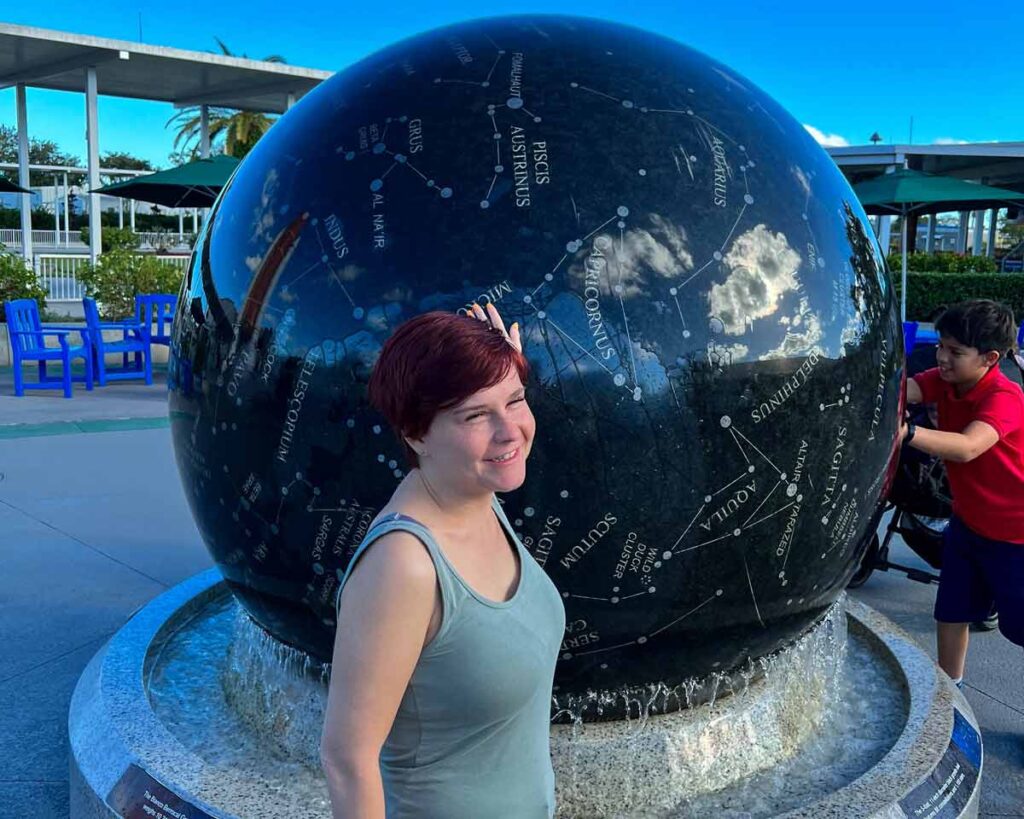
Two moments stood out for me during the visit. The first was touching the Moon rock, connecting with a piece of another world. It’s a moment I’ll never forget. The second was standing near the five-metre granite ball covered in constellations and stars. The ball moves continuously on a thin layer of water, symbolising the vastness of space. Its enormity reminded me just how small we are in the grand scheme of the galaxy—a humbling and awe-inspiring moment.
With its accessible features, enriching exhibits, and immersive experiences, Kennedy Space Centre is a must-visit destination for blind and disabled travellers. It offers a journey through the past, present, and future of space exploration, ensuring that everyone can share in the wonder of reaching for the stars.
Have you ever been to Kennedy space Centre? Would you after reading this Guide? Share with someone who is a fan of space.
Like it? Pin it!

