

This post may contain affiliate links; by clicking on and buying through these links I will earn a small commission, at no extra cost to you: helping me to keep Blind Girl Adventures running.
Have you ever wondered how to communicate with a blind person?
** DISCLAIMER** I am a blind person, and have always preferred saying this, even when my vision was much better.
Some people call themselves Visually Impaired, Sight Impaired, Severely sight Impaired, a person with low vision, or blind. Each person that you meet will have a preferred terminology, please be accepting of this and follow their lead. However for the instances of this post, I am referring to anyone with a severe sight problem as a Visually Impaired person (VIP), to make it easier, and hopefully as not to offend any readers who may be registered medically or legally blind.
Before we begin the post on how to communicate with a blind person, blindness or Visual Impairment is a spectrum, and each Visual Impairment in itself can vary from person to person. Some people have a central vision, with no peripheral some have no peripheral with no central vision, some may have a very blurry or cloudy vision, some people may only be able to see bright or contrasting colour,, others may be able to see shapes and colours, some people may only have light perception, and some people may have total vision loss, also known as black blind vision. And this is just the tip of the iceberg! I don’t claim to be an Ophthalmologist but going from 20/20 vision to deterioration over time, I’ve spoken to many different people from all walks of life with varying eye conditions, so I feel I have a basic knowledge of sight loss. I’ve noticed through the years how the public interacts with people who have visual Impairments, so I’ve decided to create a Do’s and Don’ts list on how to communicate with a blind person.
How To Communicate With A Blind Person: Do’s
1. Initial Contact:

When meeting a Visually Impaired Person (VIP) for the first time and unsure on how to interact with a blind person, introduce yourself and say: “hello, my name is …”
If you already know the person: walk straight up to them face on, gently touch their upper arm and say something like: “Hi Sassy, it’s Dave”.
In most circumstances, if they are VIPs with some useful vision, they might see you coming, and even recognise you. But it’s always better to be assertive rather than assume, especially if they weren’t expecting to see you, or it’s a crowded place. If you are meeting a VIP with new people: announce yourself first and mention that you’re with others. Allow the new people to introduce themselves individually so the VIP can attempt to distinguish them from one another.
The VIP might take a while to do this so be patient, it’s daunting meeting several people at once. When you are in conversation with a VIP, whether that be just the two of you, or in a larger group, please let the VIP know you are leaving the room, and postponing the conversation for the moment. There’s nothing worse, and more embarrassing for the VIP to be talking away to thin air when they believe that you are still a part of the conversation. That particular person may be able to laugh off the incident, but for some, it can leave the VIP flustered and cringing!
2. Guiding:
Guiding a visually Impaired Person might seem daunting to you at first but the more you do it, the more you will get used to it.
When guiding, or offering an arm as it’s commonly known, stand at the preferred side of the VIP and gently scoop your arm into their hand, their hand should either rest in the crook of your elbow, or their hand should grasp just above your elbow.
In this particular instance of how to interact with a blind person, you should always communicate with the VIP how they prefer to be guided; some people may ask you to have your arm straight, and others may ask for it to be bent. It depends on the initial grasp and how comfortable you both feel.
Generally, the VIP should grasp your arm as if they are holding a glass, 4 fingers around your inner arm, and their thumb against the outside of your arm, just above your elbow.
If a VIP is using a cane (the white stick), take the arm that is not using the cane. The cane is in the VIP’s particular hand for a reason, do not ask them to swap it to make it convenient for yourself.
You should always be a half step ahead of the VIP when guiding, this allows them to feel your body movements when you make a turn etc. Be vocal when guiding a VIP, give them clear instructions when you are turning left or right, the VIP should feel this in your body movements, but it’s always polite to give them a heads up and not encounter whiplash. 😉
Engage with the VIP and give them instructions on where the VIP is; “We’ve just passed the clock tower on our left.”
If obstacles are ahead, inform the VIP and explain that you’re going to move them around the obstacle: “We’re manoeuvring left because there is a lamppost on our right just ahead.”
3. Pavements/ stairs:
Always approach steps/ stairs straight on. When coming to pavements and stairs, let the VIP know a few paces beforehand whether it’s a step up or step down. If possible count the number of steps you are both about to encounter. If there are too many to count ahead of time, count each step as you go up or down them, also announce that “last step” as you step off. It gives the VIP and allows the VIP to prepare. As a VIP if they cannot see many steps you are encountering, they get into a rhythm, so it’s best to prepare them. 🙂
If the VIP is generally an independent traveller let them know ahead of time that there is a handrail they can use to access the stairs safely. The VIP may have a particular side they prefer to take the handrail, and in that case, they may ask you to guide them to it.
If you have to leave a VIP at any time, let them know and put them in contact with a solid object such as a wall. Let them know this, so they are not facing the wall and looking, and feeling socially awkward.
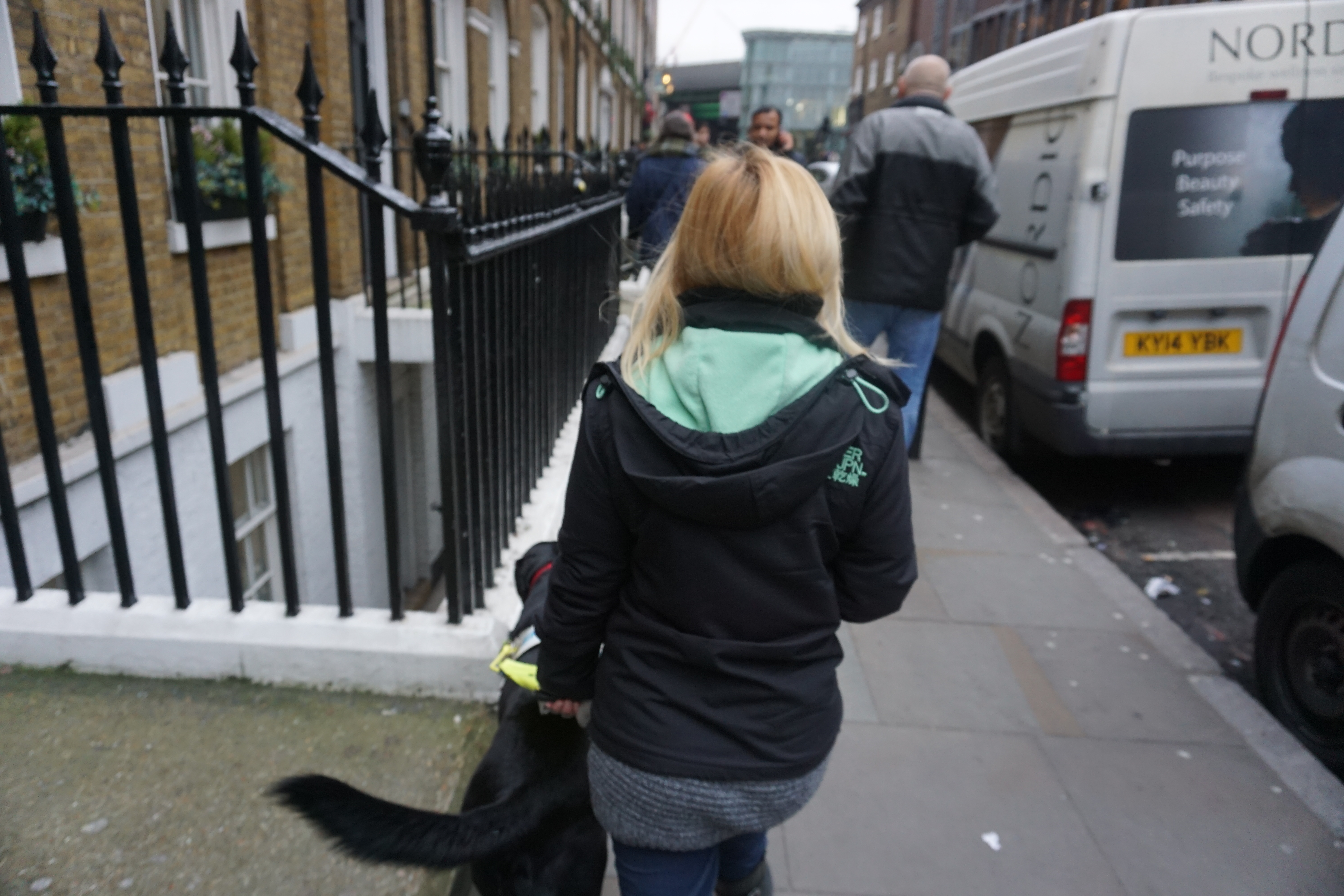
Narrow spaces are a part of navigating on a daily basis, when you’re guiding a VIP in a narrow space or area; put your guiding arm behind your back, and the VIP should follow your arm down to cup your wrist and should be walking directly behind you in a single file with their arm outstretched.
We love to have a laugh and not take life too seriously, we don’t mind if you want to take our cane for a stroll, pretending you’re blind, (until you get too scared of course and open your eyes), so go ahead and ask if you can have a go. We’ll enjoy laughing at you freaking out, and I believe it takes some of the strangeness out of having your VIP friend swinging a white cane about 🙂 Just don’t forget to leave us somewhere solid, and let us know you’re giving it back to us! 🙂
I hope you found this post useful, and have learnt something new if you didn’t know these tips already, or haven’t met a blind person before. Have I left anything out, are there any more tips you can add when it comes to how to communicate with a blind person? Or specific tips you prefer as a VIP?
Much love, Sassy x

Really enlightening article.
I’ve a friend who is visually impaired and just interact with him as I would anyone else. He’s part of our church group so I suppose I’ve taken cues from others as to how to interact with him.
Having read the article I’ve realised why certain behaviours are helpful and not. Thanks for sharing.
Hey Sarah,
I’m so thrilled that you treat your visually impaired friends just like everyone else, at the end of the day, that is all we want. If we need help we will ask for it. I’m sure your friend is very grateful for all the support you give them. Xxx
I don’t know anyone that is personally blind but I think it is important to learn how to interact with them. I think the main thing is to treat them normally because some people tend to treat the disabled/ blind as fragile and they are warriors in my eyes!
I’m so glad we finally met years ago Ana, but I completely agree with your comments and sentiments because sadly that is how society reacts around disability. Xxx
This is a really helpful list. I don’t know anyone in my every day life who is visually impaired right now but I’ll store this info away for future reference!
Thanks Laura, so glad it’s useful! Xxx
This is really interesting, I never really thought about many of the practical challenges in being guided by someone else! I don’t know any one with any sort of blindness but this would be really important to know if ever i did meet someone x
Really glad I could be of help, thank you for reading xxx
This is such a helpful post. I wouldn’t have considered half of the points you’ve made here, just because it’s out of the realm of my experience. I will be baring all these tips in mind when I need them
Thank you for sharing this, and I’m really glad to hear that you found the tips useful. Xxx
Such a great post! I never know what is or isn’t polite to do so its nice to read something coming from a visually impaired person. I always want to offer to guide but don’t want to make them feel awkward or less independent.
The best advice I can give you is to always ask and wait for a response. If a visually impaired person needs it, they will be grateful and hopefully you can have a nice nutter along the way. Xxx
This is a very helpful post, I have never considered most of the points you have raised on here
Thanks Lisa, glad I could enlighten you. 🙂 xxx
Thank you for such a useful post, I have certainly learnt a lot from it.
I am lucky that so far in life, I haven’t suffered with any eye issues. However, a recent series of trips to the emergency eye clinic at the hospital with my son (he had suspected optical cellulitis) really did make me aware of the sheer scale of different eye problems which can occur to anyone at anytime and any age. I was stunned at how full the clinic was each time, and certainly made me count my blessings.
Great post, thank you.
Anna x
Hey Anna,
Thanks for taking the time to share this. I hope things are all well with your sons eyesight now? And if not, there was always tons of support out there for all of you. Xxx
Hi Sassy, wow such an informative post. I think a lot of the time, if someone hasn’t been in these sorts of situations before it can be so daunting as you wouldn’t want to get it wrong and cause problems for the person that is Visually Impaired. Thanks so much for linking this up to #thelist xx
I definitely agree, it’s daunting, not knowing what to say or do, but the main points are to treat us as you would like to be treated and always ask before assuming. 🙂 xxx
Really great post – with so much good information, did this subject in a Finnish course last year and you’ve answered all the questions I didn’t know the Finnish for. Will share it with my friends from there x
Thanks so much Gill, I’m really glad it was useful! I hope your friends get use of the blog post as well. 🙂 xxx
I like this post 🙂 I’m blind myself, so can relate to some of the issues.
What I do think needs to be said though is that even blind people can be incredibly different in the way they like to be treated, just like other people have dos and don’ts. For example, I don’t particularly want people to count stairs for me since I tend to use my cane to find out where they start or end, and usually I hear people coming so don’t really require the ‘touch on the forearm’ bit when people are making their presence known. I do agree with other points though, like saying when you leave the room. it’s slightly annoying to be talking to thin air, indeed 🙂 I also really like the clockface explanation when going out to eat, especially when there’s multiple dishes on the table this can be really helpful to make a mental ‘map’ for lack of a better word of where all the dishes are. I don’t feel like I need to know small details about my environment if its not something I’ll be able to make use of later, but again people are very different in that as well 🙂 So don’t use this guide as the definitive blind person 101 and leave it at that, I’m sure that wasn’t Sassy’s intention when writing it 🙂 Keep these in mind like the tips they are and treat visually impaired people foremost as people …basically like how you yourself would like to be treated. i think the biggest mistake you can make is thinking you know better. If you want to help someone and they tell you they’ll manage …let them unless they really get into a dangerous situation. Read: something you might find dangerous for yourself as well like falling off a cliff or dropping down a large pothole. Not, something you might think is dangerous for them like crossing a street 😉 Overruling what they tell you and just doing your own thing at that point would be treating this person subhuman and I don’t think anyone wants that 🙂
I thoroughly agree with all the points you have raised! Blind people are all different and what may work for one of us, may not work for others, but I thought I would do this as a guideline in the hopes of educating the sighted world. 🙂 xxx
Ever time I read your posts, there is always at least one thing that always makes the think, “Wow, that wouldn’t have even occurred to me.” Like with food on the table- tell the VIP where everything is, no one wants a mouth full of brussel sprouts when they were expecting steak. Ugh. I guess I’ve had similar experiences with my hearing loss (it fluctuates daily) and people often forget- probably because I look exactly the same, and I typically miss half the conversation because they turn their head while talking so I can’t see their lips…anyway, thank you again for helping make the world a friendlier place for everyone. ❤️
Thank you so much for your support Leanne, I really appreciate the kind words and I’m glad you’ve learnt something new. Having hearing loss must be really frustrating when it comes to communicating with others. I hope you keep them in line by telling them to support you in the best way possible! 🙂 xxx
Super post as always Sassy. I truly hope if I meet you or someone else with a VI that I behave in an appropriate way that is respectful and not rude.xx
Thanks Gemma, I’m always up for a laugh, can’t speak for the rest of the blind community though 😂 xxx
Very informative. I myself have interaction with a vip person, but still feel I have learned something new.
Thank you.
So very glad to hear this, and here’s hoping that the VIP has a great sense of humour as well! 😂 xxx
I’m married to a blind person. He lost his sight to glaucoma about four years ago. And we got married just a year ago. Often times our arguments are about how I describe things to him. Guiding him is not a problem, but communicating to him is a bit of a challenge because he is highly intelligent
I want to improve and communicate better with him. I want him to see things through my eyes. How do I do that